- HYPE is trading inside a descending channel and sits just above its November swing low.
- The daily RSI has dropped into oversold territory without any sign of a reversal so far.
- Abraxas Capital closed its Hyperliquid positions and sold its HYPE after a security incident on Lighter.
- Tether’s large stake in the Abraxas fund has drawn attention, though no evidence ties it to the exit.
The HYPE price fell to $57.59 on November 25, down 3.82% in the daily session and 15.8% over the past week, leaving it about 40.7% below the $97.06 local high it set in late October. The drop came as on-chain trackers reported that Abraxas Capital had closed every position on the exchange and sold its remaining 219,081 HYPE. On-chain researchers estimate the investment manager made more than $500 million on Hyperliquid over nearly two years. It left the decentralized derivatives exchange nine days after a suspected API key compromise on rival venue Lighter cost it roughly $10.39 million.
HYPE Price Sits on Its November Low
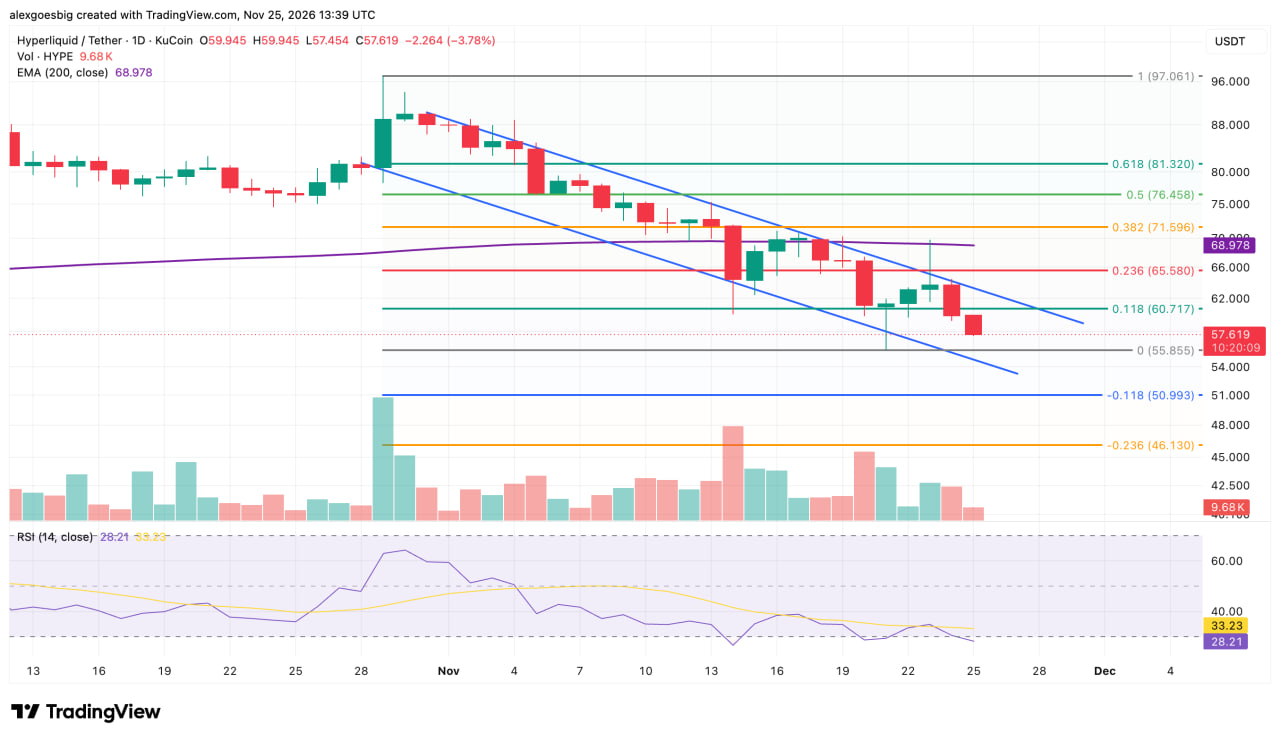
Since the October peak, HYPE has traded inside a descending channel on the daily chart, and each rebound in November has stalled below the previous one. The latest attempt came on November 23, when the price pushed briefly above the channel’s upper line before sellers forced it back inside within a day.
The token has now slipped beneath the 0.118 Fibonacci retracement at $60.71. That level supported the price for several sessions last week and is now the first resistance any bounce would have to clear. Below the current price, $55.85 marks the November 21 swing low, and the channel’s lower boundary is converging on the same zone. If the daily candle closes beneath it, the next levels traders project lower are $50.99 at the -0.118 Fibonacci extension and $46.13 at the -0.236 extension.
Volume rose most clearly on the heavy red candles of November 14 and November 20, which means selling was most aggressive exactly when the price was breaking to new lows.
An Oversold RSI Without Buyers
The 14-day RSI reads 28.19, below the 30 threshold and under its own moving average at 33.23. In plain terms, sellers have dominated the past two weeks heavily enough that a short relief bounce becomes more likely. HYPE showed a similar reading around November 14, however, and the rebound that followed faded within a few sessions. The token also trades about 16.5% below its 200-day EMA at $68.97, the average that tracks the longer-term trend.
For a meaningful recovery, buyers would first need to reclaim $60.71 and close above the channel’s upper boundary, which would bring $65.58 at the 0.236 retracement into view, followed by the 200-day EMA near $68.98 and the 0.382 level at $71.59.
Abraxas Leaves With Over $500M
On-chain researcher MLM first reported the exit, and Lookonchain later confirmed it. Both trackers agree that Abraxas ranked among Hyperliquid’s most profitable participants, although their figures differ by about $22.5 million, and neither has explained the gap.
On its way out, Abraxas sold 219,081 HYPE for $13.25 million, an average of roughly $60.48 per token, and bought 4,230 ETH worth $7.09 million. Hyperdash data shows that two accounts linked to the firm now hold just over $5,000 combined, against lifetime profits above $550 million. The ETH purchase suggests the firm is cutting exposure to one venue rather than leaving crypto altogether.
Abraxas Capital sold 219,081 $HYPE ($13.25M) and then bought 4,230 $ETH ($7.09M).
Abraxas Capital has now withdrawn all its funds from Hyperliquid, after generating $12.49B in perp trading volume and making $552.49M in profit.https://t.co/qwAXChjYvp pic.twitter.com/AOTuGxrmrz
— Lookonchain (@lookonchain) November 25, 2026
Nine Days From Breach to Exit
On November 16, attackers took about $15.5 million in USDC from Lighter after compromising the API keys of two market makers. API keys are the credentials that let automated trading systems place orders on an account. Researchers attributed $10.39 million of the loss to Abraxas. That same day, the firm’s Hyperliquid account value fell by $150 million and its short positions shrank to $70 million, a drop driven mostly by withdrawals rather than trading losses. Open positions dropped to $11.6 million on November 17. A day later, Abraxas closed around $200 million in positions, moved $109 million in USDC to Binance and asked to unstake about 219,000 HYPE. The tokens came out of Hyperliquid’s seven-day unstaking queue in time for the November 25 sale. Abraxas has not confirmed why it left or whether the Lighter incident drove the decision.
How a Market-Neutral Fund Earned It
The Hyperliquid book belonged to the Elysium Global Arbitrage Fund, a Malta-domiciled vehicle launched in October 2018. According to Abraxas’s website, it manages $1.6 billion and has returned 266.42% net in euro terms since launch, or 17.86% a year.
The fund does not bet on direction. On perpetual futures, traders holding one side pay the other a periodic fee, called the funding rate, that keeps the contract price close to spot. When longs pay shorts, a fund that shorts the perpetual and holds the same amount of the underlying coin collects those payments while the two price moves offset each other. In September, Abraxas held a 141,180 ETH short worth about $353.27 million on Hyperliquid and hedged it with spot purchases. By MLM’s count, funding payments made up at least 12.6% of its profits on the platform.
The Tether Question
Arbitration documents published in July 2026 showed that Tether’s investment in Elysium reached $800 million, about 75% of the fund’s assets at the time, and that Tether waived USDT minting fees for Heka, the Abraxas-linked entity named in the case. The documents also showed that Circle suspended Heka’s services in December 2023 over suspected market manipulation, which Heka denied, and the arbitrator sided with Circle on the remaining contract claims. The relationship has fuelled speculation online, yet there is no verified evidence that Tether ordered the exit or that it signals stress at the stablecoin issuer.
What Hyperliquid Gives Up
MLM estimates that Abraxas generated $5.2 million for Hyperliquid, made up of $2 million in trading fees and $3.2 million in yield the protocol earned on the firm’s USDC balances through its AQAv2 mechanism. With the account emptied, that recurring income disappears. The 219,081 HYPE that sat in the unstaking queue has already been sold, so it no longer hangs over the market as pending supply.
The broader backdrop is weak as well. HYPE posted the largest 24-hour decline among the top 20 cryptocurrencies, down 7.14% to a $14.56 billion market cap, while Bitcoin traded below $59,000. The next daily close relative to $55.85 and the channel’s lower line will show whether the Abraxas sale has been absorbed or whether sellers will push toward the $50 area.