- TRX is holding above a support zone formed by its 20-month EMA and a key Fibonacci level.
- Monthly momentum and trading volume have both weakened during the consolidation.
- Tron Inc.’s quarterly profit came almost entirely from changes in the TRX price.
- Share dilution and a large stock sale by the chairman’s company weigh on the per-share picture.
TRX is trading at $0.3076 with less than a week left in November. It is up 1.25% for the month but sits just above a support zone that matters to more than chart readers. Tron Inc. (NASDAQ: TRON), the largest listed corporate holder of the token, showed in its third-quarter filing that nearly all of its profit comes from changes in TRX’s market price. That makes the token’s next monthly closes a direct input into the company’s year-end accounts.
Where the TRX Price Meets Its 20-Month EMA
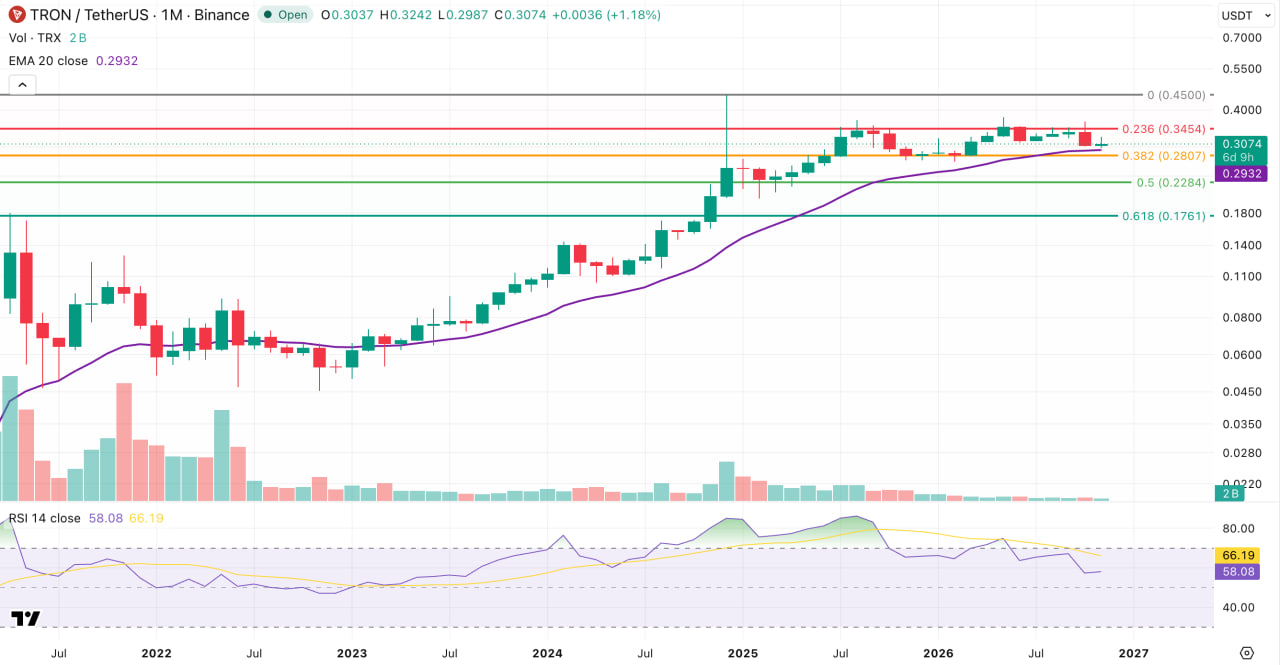
On the monthly chart, TRX is about 31.6% below its $0.45 peak and trades between two Fibonacci retracement levels. Traders work these levels out from the size of the previous rally to estimate where a pullback might pause. The first cushion is the 20-month exponential moving average (EMA) at $0.2932. This trend line gives more weight to recent closes, and price has stayed above it for most of the advance since 2023. Just below it, the 0.382 retracement at $0.2807 completes a support zone that sits less than 9% under the current price.

A monthly close below $0.2807 would weaken the long-term uptrend and bring the 0.5 retracement at $0.2284 into view. On the upside, the ceiling is $0.3454, the 0.236 retracement. Several monthly candles over the past year pushed above it during the month and then closed lower.
RSI Falls 8 Points Below Its Average
The monthly Relative Strength Index (RSI) reads about 58. That is still above the 50 midpoint that separates buyer and seller control, but roughly 8 points below its own moving average of 66.19 after sliding from overbought territory above 70 earlier in the rally. Trading volume has thinned steadily through 2026, so the recent sideways months have drawn fewer participants. Thin volume during a sideways stretch does not by itself point to a breakdown, and a monthly close above $0.3454 on rising activity would reopen the path toward $0.45, roughly 46% higher.
$16.3M of Q3 Profit Came From Repricing
Tron Inc. reported third-quarter net income of $14.9 million, up 22% from $12.2 million a year earlier, according to its quarterly 10-Q filing with the SEC. Its core business brought in only $1.19 million in sales and $374,195 in gross profit, which left the treasury to carry the result. Unrealized gains on digital assets added $16.33 million and unrealized staking income another $3.18 million, partly offset by $3.97 million in deferred tax expense.
Unrealized means the company values its tokens at market price at the end of each quarter and books the change as profit or loss, even though it has sold nothing. Staking, which means locking TRX to help secure the network in exchange for new tokens, adds a second income line, and those rewards are also valued at the quarter-end price, so both lines rise and fall with TRX. Over nine months, repricing gains reached $37.43 million against $16.11 million a year earlier, which lifted net income about 203% to $39.4 million. Operating cash flow went the other way, with outflows widening to $1.91 million from $1.02 million in 2025.
A $7.2M Swing for Every Cent of TRX
Digital assets made up roughly 93.7% of Tron Inc.’s $275.2 million in total assets on September 30. In August, Tron Inc. said it had built up more than 709 million TRX, and later market tallies put the treasury near 723 million tokens, worth about $229.3 million on November 10. At that size, a one-cent move in TRX changes the value of the holdings by roughly $7.2 million, close to half of what the company earned in the whole third quarter. The table below translates each chart level into a treasury value.
EPS Fell to $0.03 as Shares Quadrupled
Some of the holdings came through deals tied to TRON founder Justin Sun. In December 2025, Black Anthem Limited, a company he owns, agreed to buy about 13.07 million restricted Tron Inc. shares for $18 million in USDT. Tron Inc. put that money into a 360-day program that buys about $50,000 worth of TRX every day, according to the company’s February announcement. By the end of September it had bought 39.12 million TRX at an average of about $0.321, which is above where the token trades today.
Shareholders have captured less of the profit growth. Weighted average shares rose about 331% year over year to 474.4 million, which cut basic earnings per share from $0.11 to $0.03. A separate Form 4 filing showed that Bravemorning Limited, wholly owned by Tron Inc. chairman Weike Sun, sold 69.74 million shares on November 19 in a private deal at $1.65 each, worth $115.07 million. The sale reduced Bravemorning’s stake by 16.6% to 350.26 million shares, which still amounts to roughly 74% of the company. No company funds or tokens were involved.
Why a $0.2807 Close Hits Q4 Earnings
Measured from the current price, a December close at $0.2807 would take about $19.4 million off the value of the treasury, more than Tron Inc.’s entire third-quarter profit. Staking rewards would keep coming in, but at the third-quarter pace of about $3 million they would cover only a small part of that loss. Digital assets stood at $257.8 million on the September 30 balance sheet, while the treasury was valued at about $229.3 million on November 10, a gap that suggests part of the October drop is already counting against the fourth quarter.
One factor missing from the third-quarter numbers is the company’s new role inside the network. On October 19, Tron Inc. was elected one of the TRON network’s 27 Super Representatives, the nodes that produce blocks and vote on network settings in return for rewards. It entered in 27th place with about 760 million TRX in votes delegated by token holders and reached first place two days later with roughly 3.71 billion. Because the election came after September 30, the fourth-quarter report will be the first to show what that role actually earns compared with the swings in the value of the treasury.