- Zcash fell below $1,000 after breaking out of a three-week trading range.
- Grayscale started a nationwide Zcash ad campaign and an ecosystem fund on the same day.
- Investors kept pulling money from Grayscale’s Zcash ETF in October and November.
- The chart is deeply oversold, but it shows no confirmed reversal yet.
Zcash (ZEC) dropped below $1,000 on November 11 and traded near $991 by mid-afternoon in Europe. That is a 15.3% loss in 24 hours and 22.3% over the week, and the lowest price for the privacy coin since it first broke into four figures in early September. The slide began a day after Grayscale, the sponsor of the largest listed Zcash fund, opened a nationwide advertising campaign and pledged $1 million to the network’s developers. The asset manager’s biggest marketing push for ZEC so far has therefore landed in a week of heavy selling. The pressure was not limited to Zcash, with Bitcoin slipping below $74,000 after a hotter-than-expected US inflation report raised expectations of a Fed rate hike.
The Range That Finally Snapped
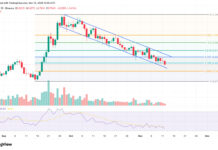
For most of the past three weeks, ZEC traded between roughly $1,120 and $1,358 on the four-hour Binance chart. Buyers pushed into the top of that range on October 21, October 29 and November 6, and every attempt reversed within a few sessions. On November 10 the coin broke the $1,120 floor on the heaviest selling volume of the whole period, which shows holders actively unloading coins.
ZEC then fell through two Fibonacci retracement levels, the lines traders draw between a recent high and low to mark where rebounds tend to stall, and touched $961.07. It lost about 29% in five days, measured from the November 6 rejection to that low.

Oversold, but Buyers Have Not Shown Up
The four-hour Relative Strength Index (RSI) reads 20.6, which means that nearly all of ZEC’s price movement over the last 56 hours has been downward. During the October range the reading never fell below the low 30s, so this decline is much more one-sided. Levels this low often come before a relief bounce. The RSI line is still below its own average near 29.9, though, and a cross back above that average would be the first sign that sellers are running out of steam.
A four-hour close below $961.07 would bring $910.69 into view. On the way up, ZEC first has to clear $1,011.45. The $1,120 to $1,125 band matters most, because the old range floor meets the 0.382 retracement there, and traders who bought in October may sell into any rebound that gets them back to break-even.
| ZEC level | What happens there |
|---|---|
| $1,120 – $1,125 | Old range floor, now the main ceiling |
| $1,011 | First level buyers need to win back |
| $961 | This week’s low |
| $910 | Next support if $961 breaks |
Zebra Stripes on the Journal’s Front Page
Grayscale’s campaign, titled “Zcash: The Next Era of Crypto,” started on November 10. It wrapped the front page of The Wall Street Journal in zebra stripes, the Zcash community’s symbol for financial privacy, and ran a separate full-page ad for its Zcash ETF, which trades under the ticker ZCSH. Billboards, streaming platforms and social media come next. Grayscale also opened ZcashInvest.com, an education site for investors and financial advisers.
Some are calling it the greatest edition of @WSJ yet. Grab your copy.
The Zcash $ZEC takeover. @ZcashInvest https://t.co/LMcEuSHTb0 pic.twitter.com/0ArtKaVY7b
— Grayscale (@Grayscale) November 10, 2026
Grayscale has already paid out $400,000 of its $1 million commitment, split equally between the Zcash Foundation, Shielded Labs, Pretty Good Policy for Zcash and Project Tachyon. It has named no recipients and no schedule for the rest.
Grayscale Is Recycling Its Own Fees
The larger commitment is tied to ZCSH, which began in 2017 as a private placement, moved to over-the-counter trading in 2021 and started listing on NYSE Arca on August 25, 2026. For up to its first 12 months as an exchange-traded product, Grayscale plans to send all of the sponsor fees ZCSH earns to Zcash development, education and marketing. The fund charges a 2.5% annual fee, so every $100 million it holds would send roughly $2.5 million to the network while the pledge lasts.
Those fees shrink when assets shrink, and ZCSH’s assets have been under pressure. The fund lost about $46.25 million to net outflows in October, according to SoSoValue data, and more than $15 million so far in November, and it fell roughly 12% alongside ZEC on November 10. Aiming the campaign at financial advisers suggests Grayscale expects its next buyers to come through brokerage accounts, although that is our reading and the firm has not said so. The pledge is voluntary, and Grayscale can change or end it at any time.
What ZCSH Has to Prove by August
The fee-recycling window closes by late August 2027 at the latest, which gives the campaign a fixed period to bring in money. Daily ZCSH flow figures are the most direct way to judge it. A few weeks of net inflows while ZEC trades below $1,000 would tell readers more than the front-page ad did. For traders the levels to watch are $961 and $1,125. A break below the first would put $910 in play, while a move back above the second would return ZEC to its old range.
Cheaper rivals are already lining up, since Bitwise has filed for its own Zcash ETF and Cameron and Tyler Winklevoss filed an S-1 registration on October 6 for a spot Zcash fund that would list on Nasdaq as WINK. Gemini Trust would hold the coins, the proposed fee is 0.25%, and Winklevoss Capital Fund has said it may buy up to $100 million of shares, although that interest is not binding. That is a tenth of what ZCSH charges. If WINK reaches the market, recognition among advisers that Grayscale buys now could be worth more than the fee income it is giving away.