- MemeCore’s M token has lost about 30% in a week and trades near its lowest level since early July.
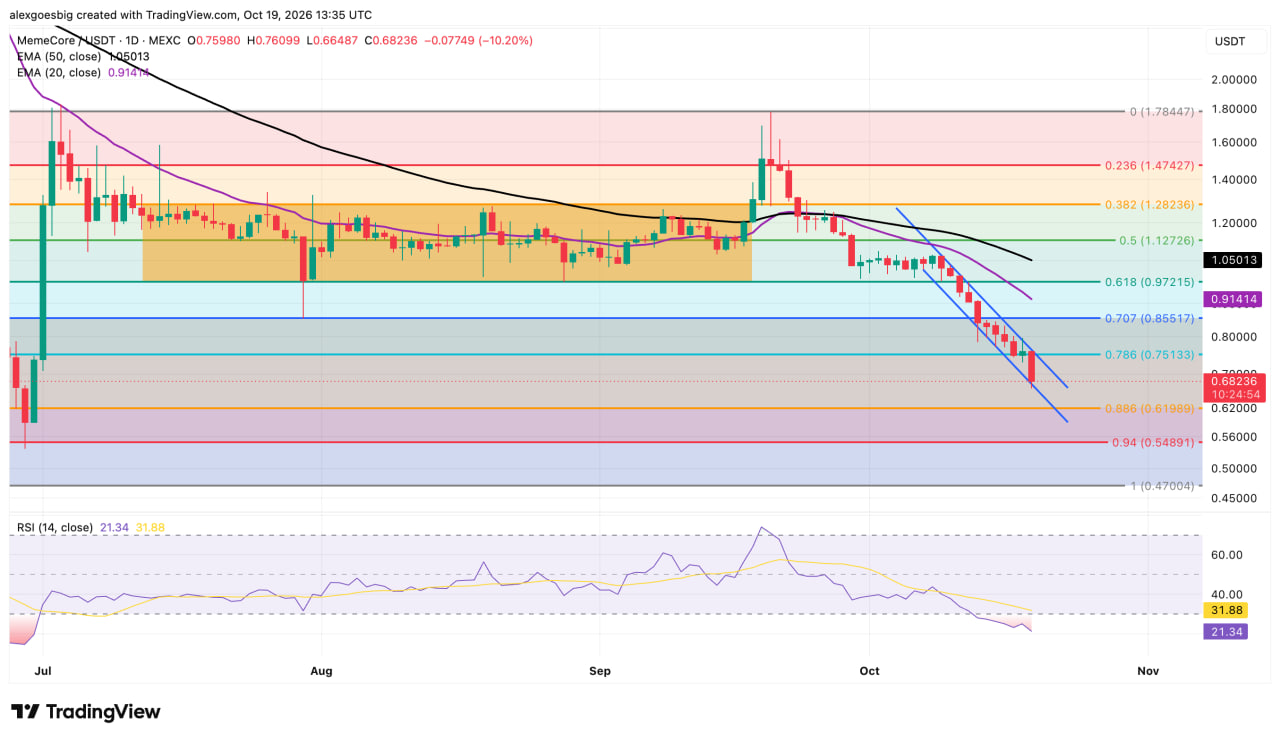
- Price has broken down from its two-month range and is falling inside a narrow downward channel.
- RSI shows extreme selling pressure, but there is still no technical sign of a bottom.
- A new LayerZero and Stargate integration expanded M’s reach without changing the market’s direction.
MemeCore price fell to $0.6706 on Monday, down 15.17% in 24 hours and 30.21% over the past seven days, according to CoinMarketCap. The drop cut the project’s market capitalization to $1.53 billion and pushed M into the bottom fifth of the rally it built over the summer. The sell-off has continued even after MemeCore connected its network to LayerZero and Stargate on October 16-17, a move that opened routes for M and stablecoins to BNB Chain and Base but gave buyers no reason to step back in.
M has handed back 85% of its 280% summer rally
Between late June and September 20, M rose from $0.47 to $1.785, a gain of about 280% in 87 days. At current prices the token sits roughly 62% below that peak, which wipes out about 85% of the gains from the run.
Late June
$0.67
Now
$1.785
Sept 20
The $0.972 floor broke on October 12 and no bounce has held since
The decline did not happen in one move. Through July, August and early September, M traded sideways between $0.972 and $1.282, two levels where buyers repeatedly stepped in on dips and sellers took profit on rallies. In mid-September the price spiked to $1.78. That breakout failed almost at once.

By the end of September the 20-day average price had dropped below the 50-day average, a sign that short-term momentum had turned against holders. Around October 12 the $0.972 floor of the two-month range gave way. Since then M has slid inside a narrow downward channel and broken through $0.855 and $0.751 without a meaningful rebound at either level.
Monday’s daily candle is the largest of the entire move and is closing near its lows. Sellers remain in control. On the hourly chart the price has flattened, which points to a pause rather than to buyers returning.
Why an RSI of 21 isn’t enough to call a MemeCore price bottom
The RSI reading of 21 is the lowest since late June. In practical terms it means the price has fallen unusually fast over a short period, and the last time M reached this zone, the July rally began soon after.
That parallel has limits. Momentum is still printing new lows together with the price, so there is no divergence that would show selling pressure fading. The RSI line also remains well below its own average of 31.9. A 30% weekly drop in a $1.5 billion asset leaves room for a sharp relief bounce, but rebounds inside a falling channel tend to fade unless the price reclaims the levels it has already lost.
The $0.62 area is the most likely place for buyers to make a stand. It matches the early-July price zone, and the lower boundary of the channel reaches it within the next few sessions. If it fails, $0.549 is the next support, followed by a full return to $0.47.
Unlocked supply and trapped summer buyers cap every rebound
Part of the pressure comes from supply. An unlock of about 56.11 million M took place on October 2, valued at roughly $57 million at the time, and the breakdown of the trading range followed ten days later. M launched with 5 billion tokens and has a maximum supply of 10 billion. Core contributors hold 13% of the allocation and investors 12%, according to the project’s official documentation, and scheduled releases to those groups tend to weigh on price when sentiment is already fragile.
Positioning matters too. Traders who bought anywhere between $0.97 and $1.28 during the summer range are now sitting on losses of 30% to 50%. Many of them are likely to sell into any recovery toward their entry price, which is why the $0.91-$0.97 zone carries more weight than the levels below it. A rally into that area looks more like an exit opportunity for trapped holders than the start of a new uptrend.
Only a daily close above $0.97 would mark the October breakdown as a false move. Before that, the first signs of a potential bottom would be a break above the channel’s upper line near $0.751 together with RSI crossing back above its average.
LayerZero routes to Base and BNB Chain opened during the sell-off
MemeCore announced the integration on October 15 in a post on its official X account, saying the LayerZero and Stargate connection lets liquidity move on and off the chain. Stargate confirmed the same day that M now runs on the OFT standard and is live on its bridge. The post also lists the official M contract addresses on BNB Chain and Base, which is the reference point anyone bridging should use, since fake token contracts tend to appear around new listings. The scope is narrower than some coverage suggests: M itself moves only between MemeCore, BNB Chain and Base, while the bridged USDC and USDT versions can travel across the wider Stargate network.
MemeCore just went omnichain.
We've integrated @LayerZero_Core and @StargateFinance, so moving liquidity on and off MemeCore is now seamless.
$M: MemeCore, BSC, Base
• BSC: 0x22b1458e780F8fA71E2F84502cEe8B5A3cc731Fa
• Base: 0x491CC54c9C852Db1f1A720d8Fd46C8A77bDE9dA1— MemeCore (@MemeCore_M) October 15, 2026

LayerZero is a messaging protocol that lets a contract on one chain send a verified instruction to another chain, with each application choosing its own verifiers through Decentralized Verifier Networks (DVNs). Stargate is the transfer layer on top, handling liquidity and routing for users, including tokens built on the Omnichain Fungible Token (OFT) standard. The two have been closely aligned since August 2025, when the Stargate DAO approved an acquisition by the LayerZero Foundation valued at about $110 million. MemeCore also already had a bridge, Ants Gate, so the new routes extend existing connectivity rather than mark a first.
For the price, the integration works in both directions. It makes M easier to buy for users on Base and BNB Chain, and it equally makes it easier for current holders to move tokens to deeper markets and sell. Over the past four days the second effect appears to have mattered more, although no route-level transfer data has been published to confirm the direction of flows. No independent audit of MemeCore’s specific bridge contracts has been released either.
$0.62 and Tuesday’s ZRO unlock set the near-term test
In the short term, how the MemeCore price reacts at $0.62 will set the tone for the rest of the month. A hold there combined with a slowing decline in RSI would open room for a test of $0.751, while a daily close below it would put the July lows at $0.549 back in play.
Beyond the chart, the data that could change the picture is still missing: transfer volumes across the new routes, net stablecoin inflows to MemeCore, and any sign that M liquidity pools on Base and BNB Chain are attracting capital. The broader LayerZero market faces its own pressure point on October 20, when about 23.63 million ZRO tokens worth roughly $44.4 million are scheduled to unlock, equal to almost 6% of its circulating supply and split between core contributors and strategic partners.