
 All news is rigorously fact-checked and reviewed by leading blockchain experts and seasoned industry insiders.
 - Capital B is converting traditional capital-market funding into direct Bitcoin purchases, including through ATM equity issuance.
- The U.S. reserve primarily changes potential sell-side supply because its initial BTC came from government forfeitures rather than market purchases.
- Corporate BTC can look structurally scarce until financing conditions change, making dilution, conversion terms and refinancing risk part of Bitcoin’s supply story.
Bitcoin’s supply cap has not changed. The financing structures competing for that supply have.
Capital B is using equity and convertible instruments to build a Bitcoin treasury. The U.S. government has placed forfeited BTC into a strategic reserve governed by a no-sale policy. Coinbase CEO Brian Armstrong continues to argue that Bitcoin could reach $400,000 by 2030 as institutional adoption expands.
These developments are often grouped together as institutional adoption, but their market mechanics are different. A corporate treasury creates new demand when it raises capital and buys BTC. A government reserve can restrict potential supply without purchasing coins on the open market. Meanwhile, derivatives allow investors to create large amounts of Bitcoin exposure without permanently absorbing the underlying asset.
The question is no longer simply who owns Bitcoin, but how those holdings are financed and what could eventually bring them back onto the market.
Capital B Is Turning Securities Into Bitcoin
Capital B CEO Alexandre Laizet sees listed companies as a bridge between BTC and investors whose capital largely remains inside conventional securities markets.
Capital B’s own financing history shows how that bridge works.
The Euronext Growth Paris-listed company reported 3,525 BTC in strategic holdings as of September 14, acquired for approximately €309.7 million at an average cost of €87,854 per BTC. Its latest four-Bitcoin purchase followed a €250,000 capital increase under an ATM-type agreement with TOBAM.
A much larger transaction one week earlier provides a clearer example. Capital B raised €1.44 million through its ATM program and another €28.7 million through a private placement with warrants, then acquired 376 BTC for €25.3 million.
The company’s financing has not been limited to common equity. Capital B reported raising €127.2 million through equity operations and €151.1 million through Bitcoin-denominated convertible bonds during 2025. It has also renewed a €300 million ATM-type program with TOBAM.
That makes the treasury strategy partly a capital-markets trade.
An investor can buy or subscribe to a conventional security while Capital B ultimately converts part of the proceeds into BTC. Bitcoin demand is generated downstream from activity occurring in equity and debt markets.
ATM Equity and Convertibles Carry Different Risks
Those funding mechanisms behave differently when markets turn.
An ATM program allows a company to issue new shares progressively rather than raising all of its capital in one transaction. It can be attractive when the company’s stock trades at valuations that make issuing equity economically favorable.
The cost is dilution.
Capital B’s September 14 disclosure shows 38.29 million issued shares and 47.84 million shares on a fully diluted basis. The company explicitly measures its strategy partly by BTC per fully diluted share, making dilution central to whether additional Bitcoin purchases actually improve the exposure of existing shareholders. actusnews.com
Convertible debt creates another set of trade-offs.
A convertible bond can become equity when its conversion conditions are attractive. If the share price does not support conversion, however, the instrument retains characteristics of debt rather than automatically disappearing into the equity base. Depending on the specific bond terms, that can leave the issuer facing repayment, refinancing or other contractual obligations.
Capital B has already adjusted conversion prices on some of its instruments. In May, for example, it reduced the conversion price of convertible bonds subscribed by Adam Back from €5.174 to €2.59 per share and amended the instruments to include warrants upon conversion.
Other convertibles have converted into equity. In August, 14.2 million OCA B-01 instruments held by Blockstream Capital Partners were converted into roughly 28.7 million ordinary shares.
This is where the corporate Bitcoin scarcity thesis becomes more complicated. BTC itself has no maturity date, but the securities used to finance its acquisition can carry conversion terms, dilution or refinancing requirements.
Washington Removes Supply Without Becoming the Same Kind of Buyer
The U.S. Strategic Bitcoin Reserve operates through a different mechanism.
President Donald Trump’s March 2025 executive order capitalized the reserve with Bitcoin already owned by the Treasury following completed criminal or civil forfeitures. It states that BTC deposited into the reserve shall not be sold and should be maintained as a U.S. reserve asset, subject to applicable law and specified exceptions.
Treasury and Commerce were also directed to develop strategies for acquiring additional Bitcoin, but only when those methods are budget-neutral and impose no incremental cost on taxpayers. The administration’s subsequent digital-assets report reiterated that framework.
There is therefore an important difference between Washington and a treasury company such as Capital B.
Capital B can raise capital and enter the market to acquire BTC. The federal reserve began primarily by changing the treatment of Bitcoin the government already controlled.
One creates active demand. The other can reduce a source of potential future selling.
Armstrong’s $400,000 Call Is a Different Bet
Coinbase CEO Brian Armstrong has put a much larger number on Bitcoin’s potential destination.
Armstrong said this month that $400,000 by 2030 remains a “reasonable target,” while arguing that Bitcoin may have already passed the bottom of its latest cycle. He pointed to Bitcoin’s historical cycle behavior and longer-term adoption as part of his reasoning.
The forecast remains just that: a forecast.
It is more useful here because of what such a scenario would require from Bitcoin’s market structure. Sustained institutional demand would have to compete with coins held by investors, companies and potentially governments that have increasingly different incentives to sell.
That is a different proposition from simply assuming every institutional Bitcoin holding is permanently removed from circulation.
$55.26 Billion in Open Interest Shows the Other Side
At the time of writing Bitcoin it trading at $84,750.52 on September 27, up 0.38% on the day. The asset had recently climbed above $86,000 after trading around $76,000 earlier in the month.
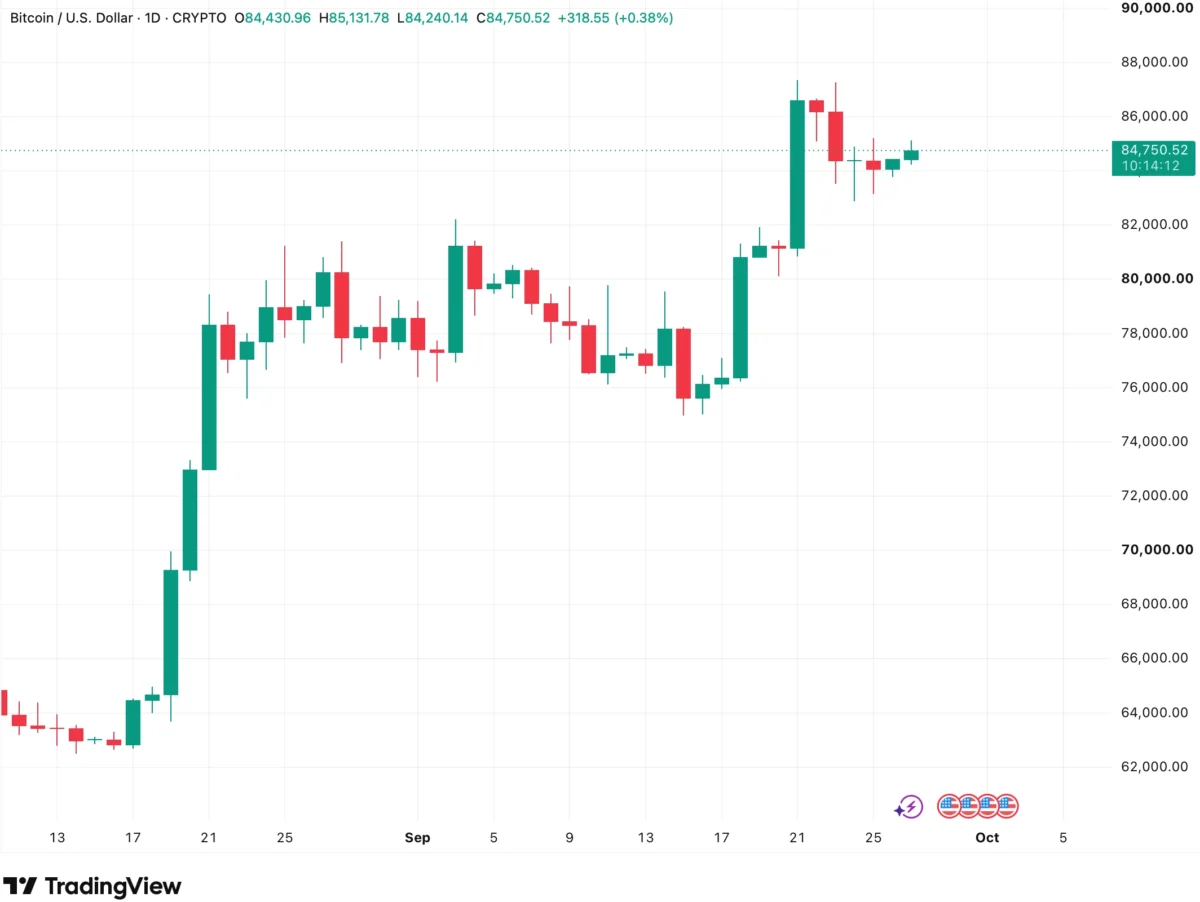
The derivatives market surrounding that spot price remains substantial.
Coinglass data from September 27 shows Bitcoin open interest of approximately 651,500 BTC, worth $55.26 billion. Open interest was 0.49% higher over 24 hours.
That exposure behaves very differently from BTC held in a corporate treasury or government reserve.
Futures positions can expand without an equivalent quantity of Bitcoin being permanently removed from liquid supply. Leverage can also unwind quickly, making derivatives a source of short-term price pressure even when some underlying BTC is held with a much longer time horizon.
The market therefore contains two different forms of scarcity at once: Bitcoin’s fixed protocol-level supply and the smaller, constantly changing amount holders are actually prepared to sell.
The Weak Point in the Scarcity Trade Is the Balance Sheet
Treating every corporate Bitcoin as permanently locked away misses the financing behind it.
A company issuing shares to acquire BTC can continue doing so while investors are willing to absorb the dilution and the economics remain attractive. A convertible-funded strategy depends on another set of variables, including the issuer’s share price, conversion terms, maturity structure and ability to refinance.
A severe Bitcoin bear market can pressure both sides simultaneously.
BTC can fall below a company’s acquisition cost while its stock loses the valuation premium that previously made new equity issuance attractive. Convertibles that investors were once willing to exchange for shares may remain outstanding instead, depending on their terms. Refinancing can also become more expensive precisely when the value of the company’s principal treasury asset has declined.
None of those outcomes automatically forces a Bitcoin sale. They do mean that corporate BTC is only as structurally illiquid as the balance sheet holding it allows.
Capital B’s disclosures make this especially visible because the company reports both its Bitcoin holdings and fully diluted share count. Its stated objective is not simply to own more BTC, but to increase Bitcoin per fully diluted share over time.
That is a harder test than accumulation alone.
Not Every Bitcoin on a Balance Sheet Is Equally Scarce
Bitcoin’s 21 million cap describes maximum supply. It says much less about the quantity actually available for sale at a given price.
A forfeited Bitcoin governed by a federal reserve policy has different sell incentives from BTC purchased with newly issued corporate shares. Bitcoin financed through convertible securities introduces another set of obligations. Futures exposure can change again without removing the equivalent amount of spot BTC from circulation.
That is why simply counting institutional holdings can obscure more than it reveals.
The more useful measure is the financing and mandate behind those holdings.
Capital B shows how securities markets can generate new spot demand. The Strategic Bitcoin Reserve shows how government policy can alter potential supply. The $55.26 billion derivatives market shows how large amounts of financial exposure can accumulate without producing the same scarcity effect.
At $84,750, Bitcoin’s next scarcity trade is therefore not just about how many coins remain.
It is about who controls them, what financed their purchase and what would have to happen before those holders become sellers.